Floating Research Outpost, Baa Atol, Maldives
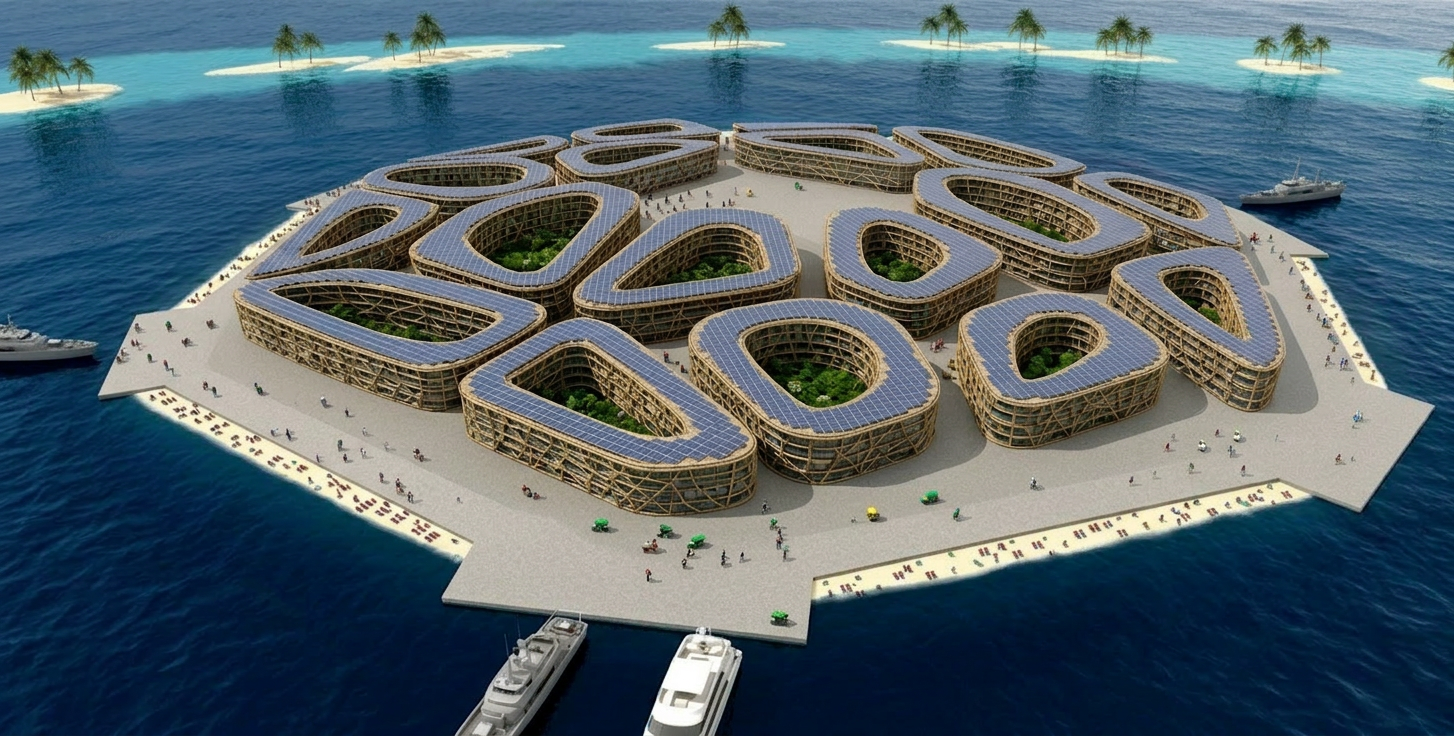
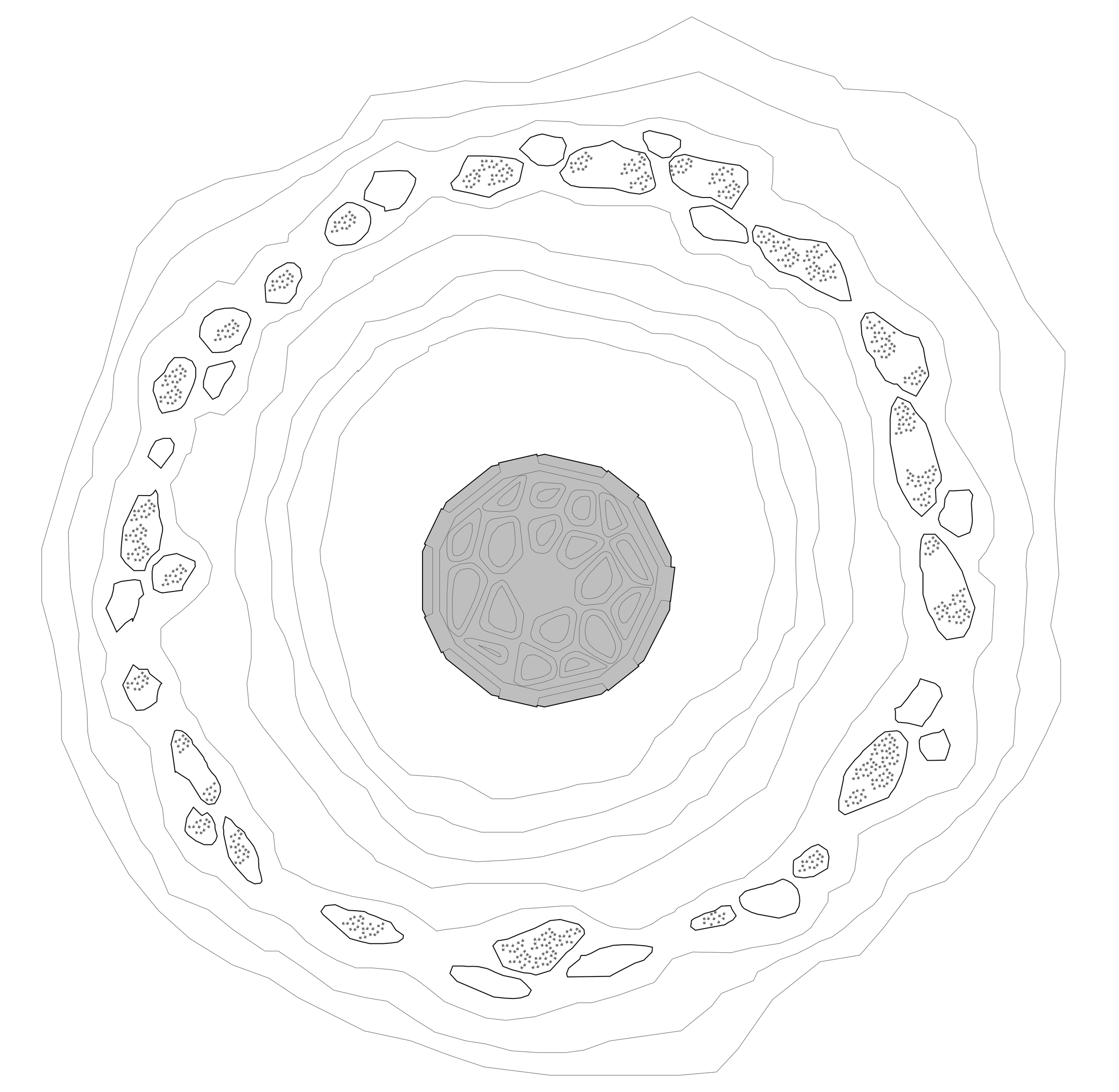
Situated within the protected waters of the Baa Atoll UNESCO Biosphere Reserve, ATOL is a permanent floating infrastructure designed to address the existential threat of rising sea levels in the Maldives. The project envisions a sociological symbiosis, providing a new home for approximately 6,000 inhabitants—a mixed population of indigenous communities displaced by climate change and a global task force of climate scientists and oceanographers. Spanning a radius of 600 meters, this floating city is not merely a survival raft, but a thriving research ecosystem where traditional Maldivian knowledge of the sea integrates with cutting-edge ecological preservation efforts.
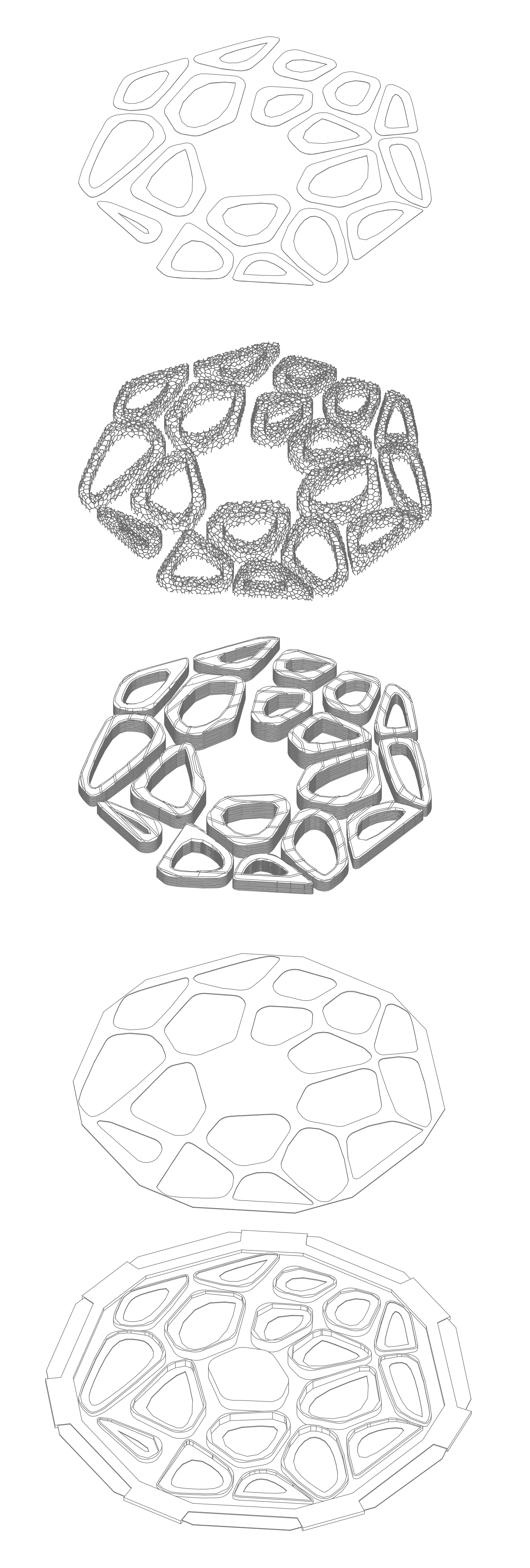
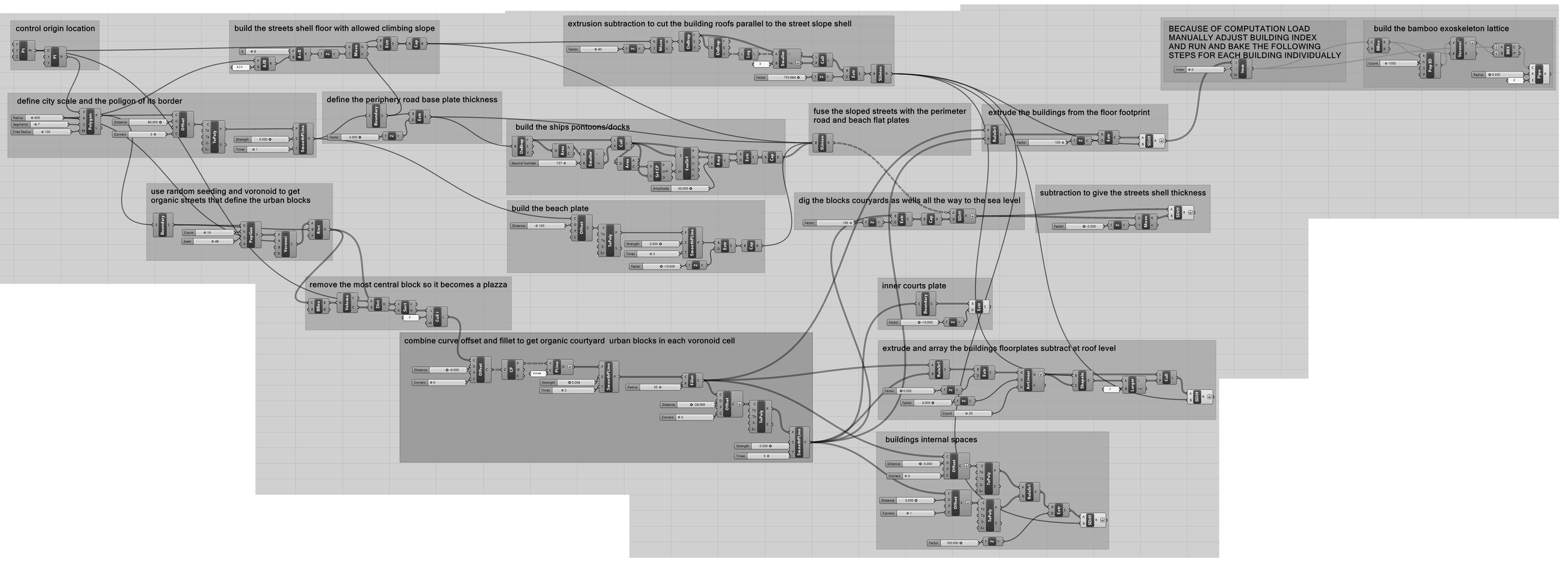
The master plan is generated through a fully parametric workflow, utilizing Voronoi algorithms to create an organic urban morphology that mimics the cellular growth patterns of the surrounding coral reefs. The city is composed of individual floating modules that function as distinct urban blocks, their shapes optimized to fit naturally within the lagoon environment. By moving away from rigid grids, the parametric arrangement allows for fluid movement and structural flexibility, ensuring the settlement works with the ocean currents rather than resisting them.
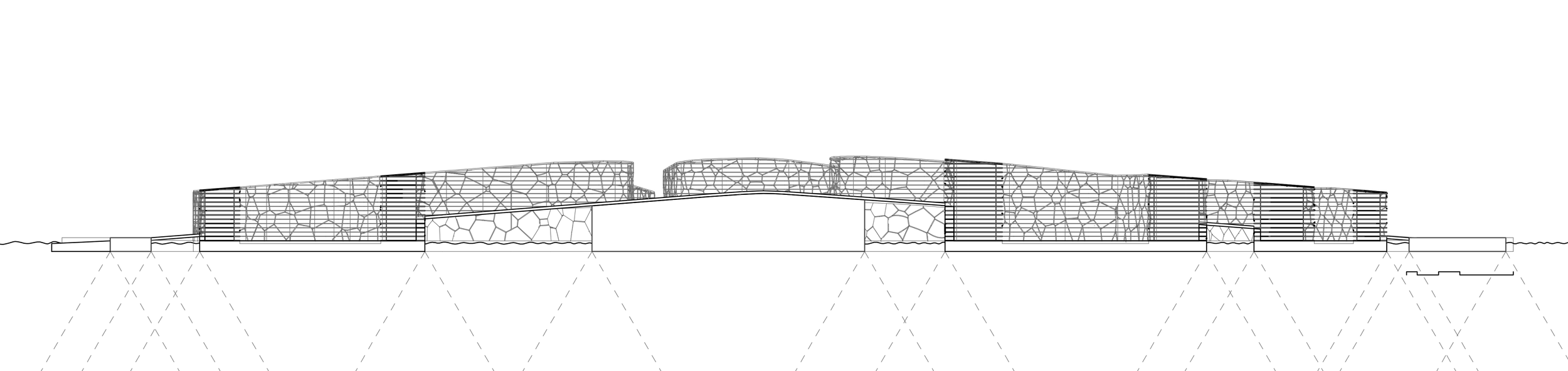
A defining feature of the design is its inverted topography. The street network slopes gently upwards from the peripheral shoreline toward the center of the city. This strategic elevation ensures visual equity, granting every resident a clear view of the ocean horizon regardless of their location within the density of the settlement. The urban fabric converges on a grand central plaza that serves as the civic heart of the community, while the perimeter is lined with artificial beaches and logistical pontoons, acting as a permeable membrane for supply boats and marine transport to dock.
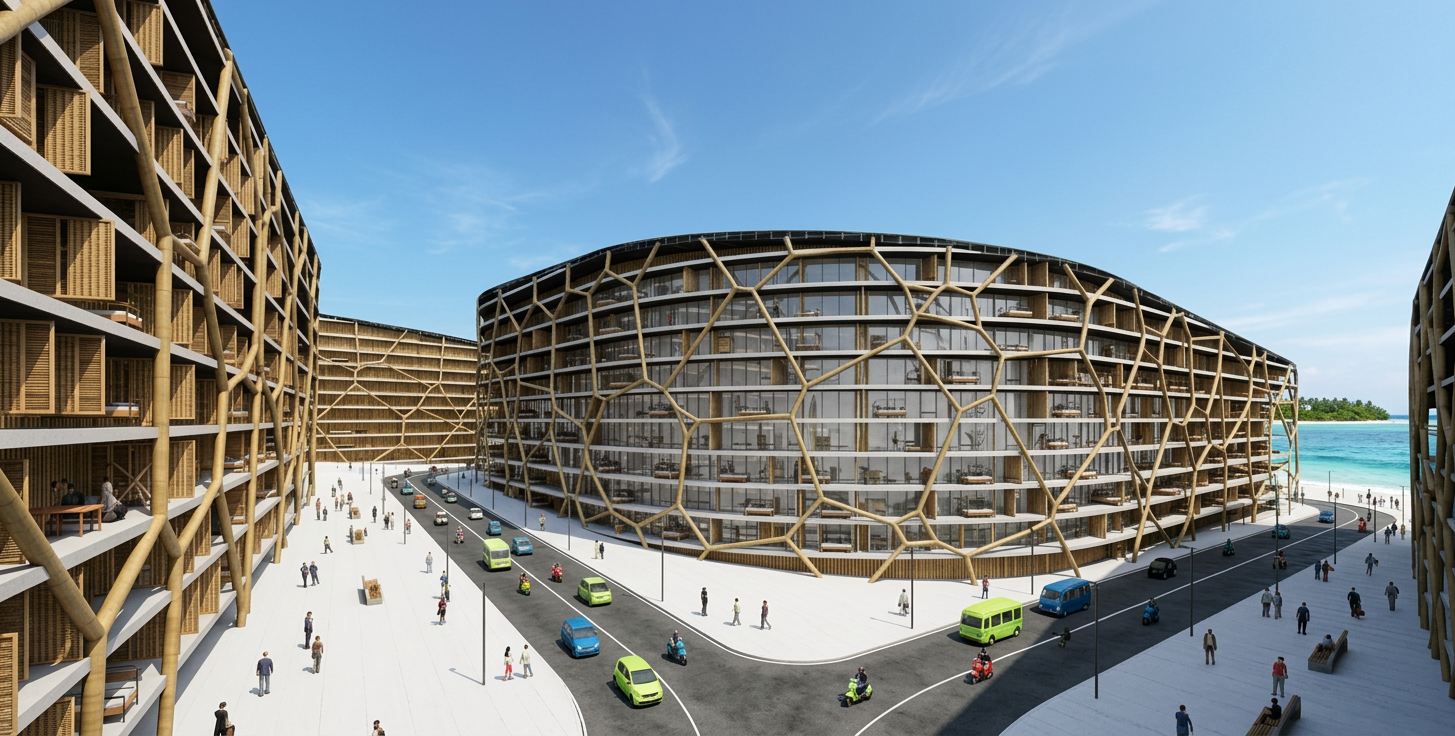
Life within the modules is designed for self-sufficiency and climatic comfort. Each urban block is organized around a private internal courtyard dedicated to agricultural gardens, allowing residents to grow food and maintain food security. The narrow, organic street grid is calibrated to maximize shade, protecting pedestrians from the harsh tropical sun and creating cool, breezy microclimates. The architecture prioritizes passive cooling, ensuring that the transition from land-based living to a pelagic existence maintains a high quality of life.
The construction logic combines heavy durability with renewable, lightweight tactility. The city rests on a foundation of hollow reinforced concrete pontoons that provide the necessary buoyancy and inertia against ocean swells. Rising from this base, the buildings utilize a corrosion-resistant light steel exoskeleton for structural rigidity, which is enveloped in a locally sourced bamboo lattice. This bamboo façade serves as both a shading device and a biophilic texture, softening the visual impact of the city and allowing the architecture to breathe and age naturally alongside the marine environment.
Research
Social Aspects: Fostering a Resilient Marine Community
The primary sociological objective of the Atol project is to mitigate the trauma of climate displacement by creating a symbiotic society. The city is sized to house approximately 6,500 inhabitants, integrating indigenous Maldivian populations—forced from their islands by rising sea levels—with a transient global community of climate researchers and oceanographers. This mix fosters a unique knowledge exchange: local ancestral understanding of the ocean currents blends with high-tech ecological data gathering. The urban design reinforces equity through its "stadium-like" section; by sloping the streets and building heights upwards toward the center, the master plan guarantees that every resident maintains a visual connection to the horizon, preserving the cultural imperative of living in sight of the sea.
Aesthetic Aspects: Contextual Biomimicry
Rather than imposing a rigid grid onto the fluid ocean surface, the project utilizes parametric Voronoi algorithms to generate an organic urban morphology. The aesthetic approach is one of deep contextual integration, where the city modules mimic the cellular growth patterns of the coral reefs beneath them. The harshness of the necessary marine engineering is softened by a "skin" of treated bamboo that wraps the steel exoskeletons. This choice ensures that the floating city does not appear as an alien technological injection, but rather as a natural extension of the atoll, blending the built environment with the organic textures of the surrounding lagoon.
Material Aspects: Durability and Sustainability in Extreme Conditions
The material strategy is defined by a hybrid logic of heavy durability and lightweight renewability. The base of the city consists of hollow, marine-grade concrete pontoons, chosen for their high inertia and ability to resist salt corrosion while providing stable buoyancy. Above the water line, the architecture transitions to a lightweight steel lattice acting as a structural exoskeleton, offering the necessary tensile strength to withstand tropical storms. This steel frame is clad in bamboo, a rapidly renewable material that provides essential shading and reduces the overall carbon footprint of the superstructure, creating a protective, breathable envelope against the equatorial sun.
Engineering and Construction Aspects: Prefabrication for Minimal Impact
To minimize disruption to the sensitive Baa Atoll ecosystem, the project employs a fully modular construction methodology driven by parametric computation. The urban blocks are designed as discrete floating units that can be prefabricated off-site and towed to the location. The hollow concrete foundations serve as their own transport barges, while the steel and bamboo superstructures are assembled using dry-joint techniques. This approach allows for scalability—the city can grow or retract organically by adding or detaching modules—and ensures that the construction process does not damage the seabed or the surrounding coral reefs.
Urban and Environmental Aspects: Off-Grid Self-Sufficiency
The urban plan is calibrated for metabolic independence and climatic comfort. The orientation of the sloping streets is optimized to channel prevailing breezes, ensuring that the public realm remains shaded and cool. Environmentally, the city functions as a closed-loop system; the Voronoi-shaped courtyards within each residential block serve as agricultural "green lungs," allowing for local food production and reducing reliance on imported goods. The peripheral ring of the city is activated by pontoons and beaches that manage logistics, while the internal sloping topography creates a gravity-fed infrastructure for rainwater harvesting, directing freshwater to storage within the floating hulls.
Economic Aspects: Long-Term Value and Viability
Beyond functioning as an emergency shelter, the Floating Research Outpost is designed as an economic engine for the "Blue Economy." By co-locating high-level research facilities with residential zones, the project attracts international funding and scientific tourism, creating a revenue stream that supports the maintenance of the floating infrastructure. This model transforms the concept of climate adaptation from a sunk cost into an investment in global ecological preservation. It offers a viable alternative to costly and temporary sea walls, providing a permanent, adaptable asset that preserves the Maldivian nation's sovereignty and economic capacity despite land loss.